Just-in-Time Learning vs Just-in-Case Learning: What Actually Works?
In a world where skills expire faster than job titles evolve, the way organizations approach learning has quietly become a competitive advantage. Yet many teams still rely on a familiar dilemma: should employees be trained before they need a skill, or at the exact moment they need it?
This is where the contrast between just-in-case learning and just-in-time learning becomes more than a theoretical debate. It shapes how effective your corporate training programs truly are, and whether your workforce is prepared for what’s next or stuck catching up.
Understanding the Two Approaches
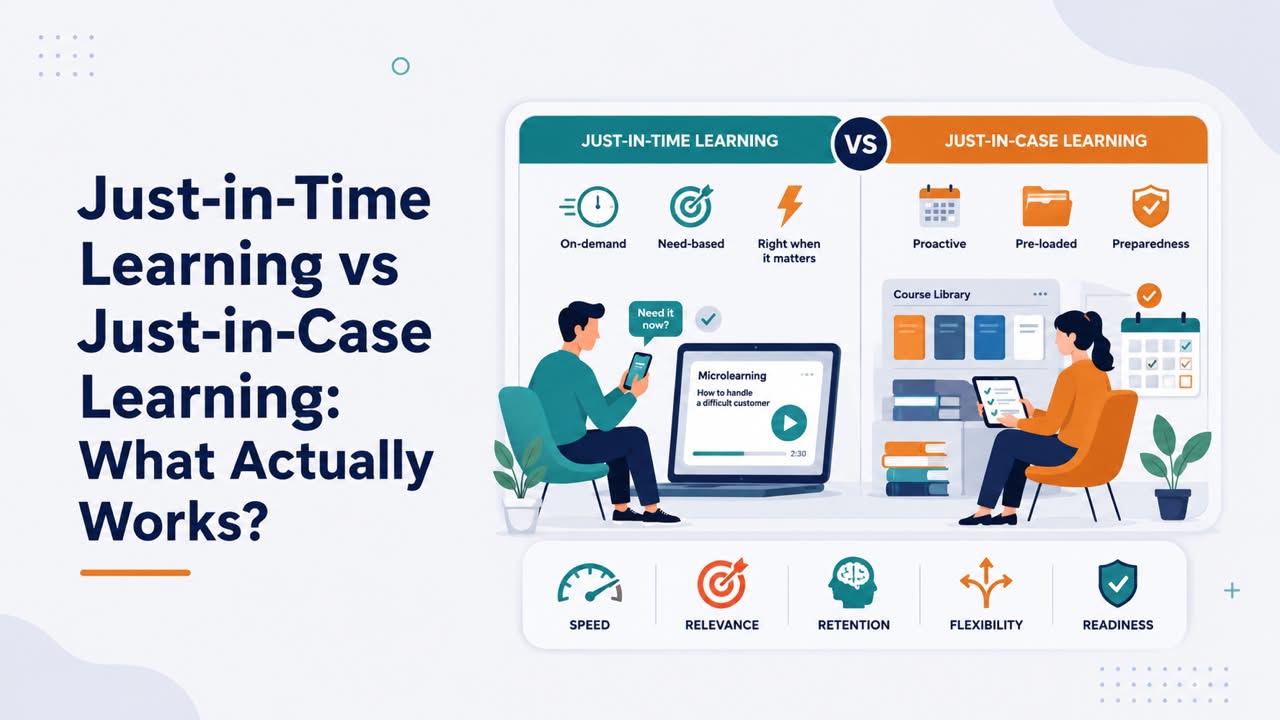
Just-in-case learning is the traditional model most organizations grew up with. Employees are trained in advance, often through structured employee training programs, classroom sessions, or long-form modules delivered via corporate LMS solutions. The idea is simple: equip people with knowledge they might need in the future.
This approach is deeply embedded in professional certification training, leadership training programs, and technical training programs such as IT certification training, data science certification training, or even certified Six Sigma Green Belt training and certified Six Sigma Black Belt training. It builds foundational capability, ensures compliance, and supports long-term workforce development training.
On the other hand, just-in-time learning is designed for immediacy. It delivers knowledge exactly when an employee needs it, during a task, a decision, or a moment of uncertainty. Think quick modules within eLearning solutions, short videos embedded in workflows, or support content developed through instructional design services for real-time use.
This model thrives in fast-paced environments, especially within digital transformation training, agile training programs, and hands-on technical training where learning needs to keep pace with constant change.
Where Just-in-Case Learning Still Works
Despite criticism, just-in-case learning hasn’t become obsolete, it has simply become more specific in where it delivers value.
For roles that require deep expertise, structured knowledge is non-negotiable. Fields like online IT training courses, financial modelling training, IoT training programs, and DevOps certification training demand a strong foundation before practical application can even begin.
Similarly, corporate leadership training and transformational leadership training benefit from reflective, immersive formats. You can’t compress leadership development into quick fixes. Programs like leadership coaching programs or women’s leadership development programs require time, context, and continuity to create meaningful change.
In these cases, just-in-case learning supports:
- Long-term capability building
- Standardization across teams and geographies
- Structured progression within enterprise learning and development
It’s also critical for compliance, onboarding, and building baseline competencies identified through skill gap analysis and employee competency assessment.
Where Just-in-Time Learning Outperforms
The real shift is happening in how organizations handle day-to-day performance.
Employees no longer have the luxury, or patience, for long training cycles when facing real-time challenges. Whether it’s debugging a system, adapting to a new tool, or navigating a client scenario, they need answers instantly.
This is where just-in-time learning shines.
Modern corporate training solutions are increasingly integrating:
- Bite-sized content through eLearning content development
- Embedded learning within workflows
- Mobile-first and virtual training solutions
- Contextual resources for remote corporate training
In environments driven by agile transformation training or organizational transformation consulting, learning must move at the speed of change. Waiting for scheduled sessions simply doesn’t work.
Just-in-time learning improves:
- Knowledge retention (because it’s applied immediately)
- Productivity (less time away from work)
- Engagement (learning feels relevant, not forced)
It also aligns naturally with blended learning programs and immersive learning experiences, where formal training is complemented by real-time reinforcement.
The Problem with Choosing Only One
Here’s where many organizations go wrong, they treat this as an either-or decision.
Relying only on just-in-case learning leads to information overload. Employees sit through extensive corporate technical training programs, only to forget most of it before it’s ever applied. It becomes a checkbox exercise rather than a performance driver.
On the other hand, relying solely on just-in-time learning creates shallow understanding. Without foundational knowledge, employees may solve immediate problems but struggle with complex decision-making or innovation.
Neither approach, in isolation, is enough.
What Actually Works: A Blended Strategy
The most effective organizations don’t choose between the two, they integrate both into a cohesive learning ecosystem.
A strong strategy typically looks like this:
1. Build Foundations with Just-in-Case Learning
Use structured corporate training programs to establish core skills. This includes:
- IT training courses and emerging technology training
- Leadership development training
- Certification-led learning like data science training or Six Sigma programs
These are often delivered through customized corporate training, supported by learning and development consulting and aligned with business goals through competency mapping.
2. Reinforce with Just-in-Time Learning
Layer in real-time support through:
- Microlearning modules within corporate LMS solutions
- On-demand resources for hands-on technical training
- Performance support tools integrated into workflows
This ensures learning doesn’t stop when the training session ends, it continues in the flow of work.
3. Scale with Technology and Design
Modern eLearning solutions, combined with strong instructional design services, make it possible to deliver both approaches seamlessly across multi-location training programs, global training programs, and even cross-border training delivery.
For organizations operating globally, this is critical. Whether it’s online training USA, worldwide corporate training, or programs led by an international training provider, consistency and accessibility define success.
The Role of Personalization
Another key factor is relevance.
Through tools like skill gap analysis and employee competency assessment, organizations can move toward more targeted learning journeys. Not every employee needs the same balance of just-in-case and just-in-time learning.
For example:
- A new hire may need more structured learning
- An experienced professional may rely more on real-time support
- A leader undergoing change management training may need both reflection and application
This is where customized corporate training becomes essential, designing learning experiences that adapt to roles, industries, and business goals.
The Future of Learning Is Contextual
The shift isn’t just from one model to another, it’s toward context-driven learning.
As organizations invest in digital transformation training, agile consulting services, and broader organizational transformation consulting, learning is becoming more embedded, more responsive, and more aligned with real work.
The future lies in:
- Learning that adapts in real time
- Systems that connect knowledge with performance
- Experiences that blend structure with flexibility
Final Thoughts
So, what actually works, just-in-time or just-in-case learning?
The honest answer is: both, but only when used intentionally.
Just-in-case learning builds the foundation. Just-in-time learning brings it to life.
Together, they create a learning ecosystem that doesn’t just inform employees, but enables them to perform, adapt, and grow in a world where change is the only constant.
And that’s ultimately what effective enterprise learning and development is meant to do.
