
Why Most Employees Forget Training Within Weeks
Organizations invest heavily in employee development, yet many learning initiatives fail to produce long-term results. Employees attend workshops, complete online modules, and participate in training sessions, but within a few weeks, much of that information fades. This training retention problem is one of the biggest challenges facing corporate learning programs today.
Understanding why employees forget training is essential for building learning programs that truly work. Research in cognitive science and workplace learning shows that knowledge loss is not unusual—it is a natural outcome when training is delivered without reinforcement, application, or meaningful engagement.
For organizations seeking to improve learning retention in corporate training, it is important to understand the key factors that cause employees to forget what they learn.
The Forgetting Curve in Workplace Learning
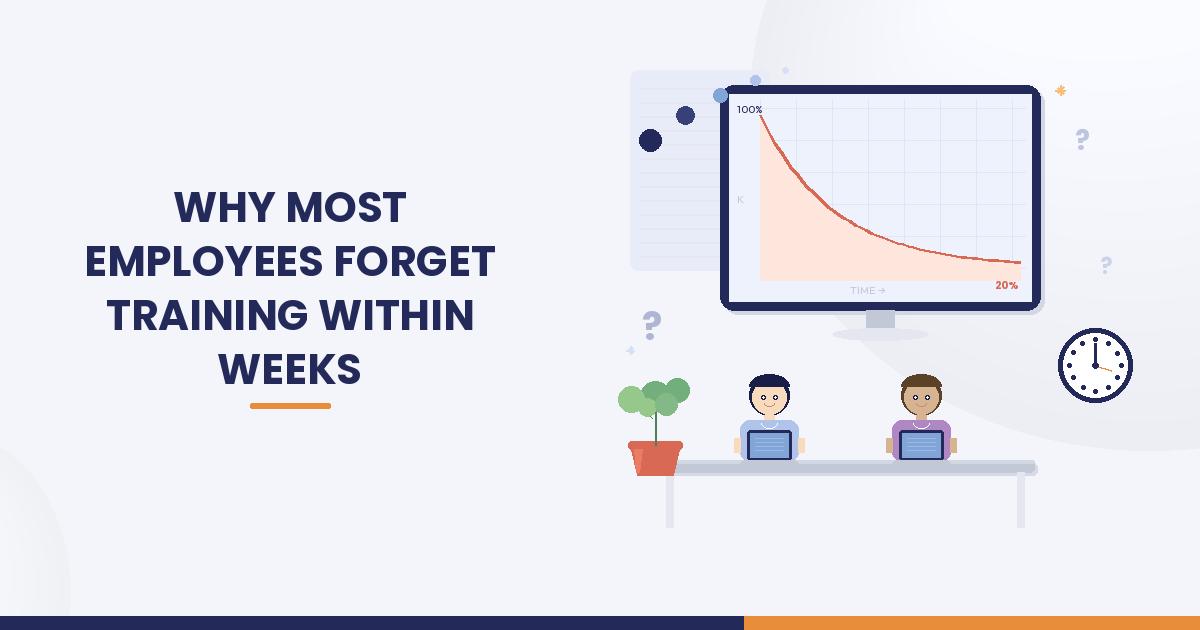
One of the most well-known explanations for knowledge loss is the forgetting curve workplace learning phenomenon. This concept suggests that people naturally forget new information over time if it is not reinforced or used.
After a training session, employees may initially remember most of the material. However, without review or practice, memory retention drops significantly within days or weeks. This is why employees often struggle to recall key concepts from training programs they attended only a short time ago.
The brain prioritizes information that is frequently used. If employees do not apply what they learned, their minds gradually discard the information to make space for more relevant knowledge.
Information Overload During Training
Another major reason employees forget training is information overload. Many corporate programs attempt to cover too much material in a limited amount of time. Participants are expected to absorb multiple concepts, frameworks, tools, and procedures in a single session.
While this approach may seem efficient, it often overwhelms learners. When too much information is delivered at once, the brain struggles to organize and store it effectively.
As a result, employees may remember only a few key points while the majority of the training content fades quickly. Effective learning programs focus on fewer concepts at a time and allow learners to process and apply information gradually.
Lack of Real-World Application
Learning becomes meaningful when it connects directly to real work. Unfortunately, many training programs remain theoretical rather than practical.
Employees may attend sessions filled with presentations, slides, and explanations but receive limited opportunities to apply what they learn. Without practice, knowledge remains abstract and difficult to retain.
One of the most effective ways to improve learning retention in corporate training is by integrating real-world scenarios, problem-solving activities, and hands-on exercises. When employees actively use new skills, their brains strengthen those memory pathways.
Minimal Reinforcement After Training
Training should not end when a workshop concludes. However, many organizations treat learning as a one-time event rather than an ongoing process.
Employees often return to their daily responsibilities immediately after training with little follow-up. Without reinforcement through reminders, discussions, or refresher sessions, the newly learned material quickly fades.
This is a major contributor to the training retention problem. Continuous reinforcement—through microlearning, short quizzes, team discussions, or coaching—helps employees revisit and strengthen what they have learned.
Limited Manager Involvement
Managers play a critical role in reinforcing training, yet they are often excluded from the learning process.
When managers actively support learning, they encourage employees to apply new skills, discuss insights from training sessions, and provide feedback. This creates an environment where learning becomes part of everyday work.
However, if managers are unaware of training content or fail to reinforce it, employees may struggle to integrate new knowledge into their routines. Without leadership support, training remains disconnected from real workplace expectations.
Passive Learning Methods
Traditional corporate training often relies heavily on passive learning methods such as long lectures, slide presentations, or recorded videos. While these approaches can deliver information efficiently, they do not always promote deep understanding.
Active learning strategies—such as group discussions, simulations, role-playing, and collaborative exercises—encourage learners to engage with the material. This engagement strengthens memory and improves retention.
When employees participate actively in the learning process, they are far more likely to remember and apply the concepts later.
Lack of Personal Relevance
Employees are more likely to remember information that feels relevant to their roles and goals. If training content appears generic or disconnected from their daily responsibilities, learners may struggle to stay engaged.
For example, a leadership training program designed for senior managers may not resonate with entry-level employees. Similarly, technical training that lacks clear workplace examples may feel abstract and difficult to apply.
Customizing training to reflect specific roles, challenges, and real-world scenarios can significantly improve learning outcomes.
Time Pressure and Workplace Distractions
Even when employees are motivated to learn, workplace realities often interfere with retention. Busy schedules, urgent deadlines, and constant communication can distract learners from focusing fully on training.
Employees may attend sessions while simultaneously responding to emails or thinking about unfinished tasks. This divided attention reduces their ability to absorb and remember new information.
Organizations that create dedicated learning time and minimize distractions during training can help employees engage more deeply with the material.
Improving Learning Retention in Corporate Training
Understanding why employees forget training is the first step toward building more effective learning programs. Organizations that want to address the training retention problem should focus on strategies that reinforce learning over time.
These strategies may include spaced learning sessions, microlearning modules, real-world practice opportunities, manager involvement, and continuous feedback. When learning becomes integrated into everyday work rather than isolated events, retention improves significantly.
Ultimately, effective corporate learning is not about delivering more training—it is about creating experiences that employees remember, apply, and build upon long after the session ends. By addressing the factors behind the forgetting curve workplace learning, organizations can transform training from a temporary activity into lasting capability development.
